

Weather alert: UAE braces for up to 5°C temperature rise in April as dust winds and rain loom
Transitional spring brings fluctuating atmospheric systems and changing conditions

DUBAI – The United Arab Emirates (UAE) is set for a period of dynamic and fast-changing weather conditions throughout April, with temperatures forecast to rise by between 3°C and 5°C compared with March, according to the National Centre of Meteorology (NCM).
The month marks the country’s transition into spring, a season often associated with shifting atmospheric pressure systems and unpredictable weather patterns.
As daylight hours lengthen due to the sun’s apparent movement northwards, a gradual warming trend is expected across the Emirates. However, this rise in temperature will be accompanied by episodes of cloud cover, rainfall, and wind activity, creating a varied weather outlook.
Spring transition
April forms part of the UAE’s first transitional season, where atmospheric systems frequently fluctuate. The NCM explained that low-pressure systems moving from west to east are expected to influence the region more prominently during this period, including extensions linked to the Red Sea and surrounding weather systems. At the same time, the Siberian high-pressure system is likely to weaken, allowing more variability in weather conditions.
الطقس المتوقع خلال عطلة نهاية الأسبوع على بعض مدن دولة #لإمارات #المركز_الوطني_للأرصاد
— المركز الوطني للأرصاد (@ncmuae) April 3, 2026
Weather forecast during the weekend over some #UAE cities #NCM pic.twitter.com/B6Jb1ozT8p
When these low-pressure systems deepen, cloud formation increases, raising the likelihood of rainfall across scattered areas. While humidity levels are expected to decline slightly compared with March, particularly in the latter half of the month, early April may still witness fog and light mist forming in isolated locations. These conditions are forecast to become less frequent as the month progresses.
Short-term forecasts indicate unsettled weather conditions across the UAE, with intermittent rainfall expected from light to moderate intensity in several regions between Saturday and the end of the following week. These conditions are likely to be accompanied by active winds, particularly from the north-west, which may raise dust and reduce visibility in exposed areas.
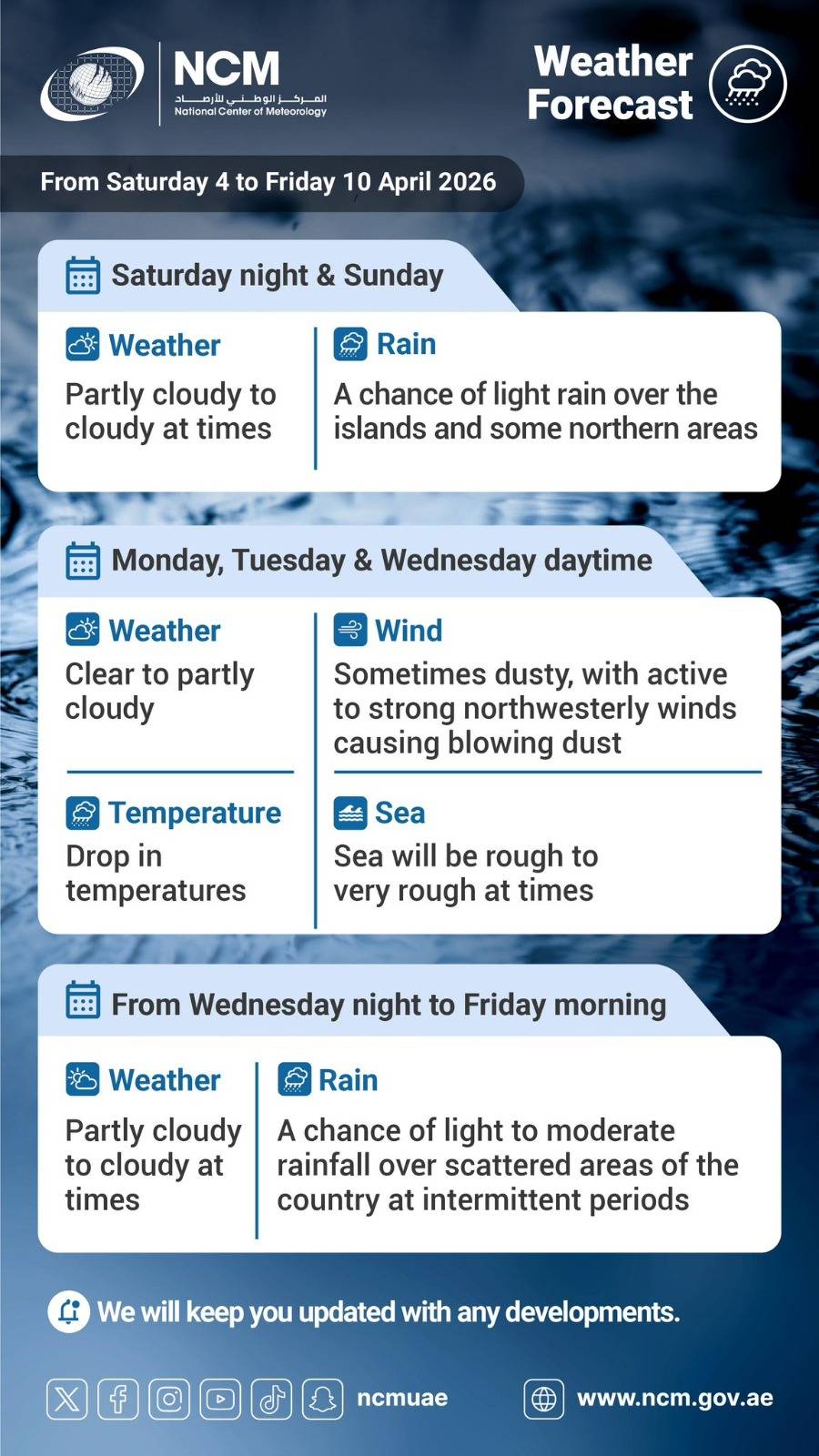
During periods of instability, sea conditions are also expected to become rough to very rough at times, affecting maritime activities across both the Arabian Gulf and the Sea of Oman. A brief drop in temperatures is anticipated during these episodes, offering short-lived relief before the overall warming trend resumes.
From Saturday night into Sunday, weather conditions are forecast to turn partly cloudy to cloudy at times, with a chance of light rain over islands and northern regions. By early next week, clearer skies may return temporarily, although dusty conditions are expected due to strengthening north-westerly winds.
Temperature rise
As April progresses, temperatures are expected to steadily increase across the country, reflecting the seasonal shift. The weakening of high-pressure systems and the growing influence of low-pressure systems will contribute to this gradual warming trend.
#أعلى _درجة_حرارة سجلت على الدولة هذا اليوم 31.3 درجة مئوية في أم الغاف (رأس الخيمة) الساعة 13:15 بالتوقيت المحلي لدولة الإمارات.
— المركز الوطني للأرصاد (@ncmuae) April 3, 2026
The highest temperature recorded over the country today is 31.3°C in Umm Al Ghaf (Ras Al Khaimah) at 13:15 UAE Local time. pic.twitter.com/Y6tJLTE3Os
Daytime conditions will feel warmer, particularly in coastal and inland areas, while mountainous regions will remain relatively cooler. Despite the overall rise, intermittent weather systems will continue to interrupt the pattern, bringing occasional cloud cover, rainfall, and gusty winds.
Humidity levels are forecast to decline slightly in the second half of the month, though early mornings may still see pockets of mist or fog in certain areas. These occurrences are expected to diminish as the month advances, giving way to clearer but warmer conditions.
Dust and seas
Wind activity is set to play a key role in April’s weather pattern, with north-westerly winds occasionally reaching fresh to strong levels. These winds are capable of lifting dust and sand, leading to reduced visibility in some regions, particularly during peak daytime hours.
Sea conditions will vary in response to these winds, with forecasts indicating moderate to rough seas at times, especially during periods of increased wind activity. Maritime users are advised to remain alert to changing conditions, as wave heights and sea states may fluctuate rapidly during unsettled weather periods.
Temperature readings for the early part of the period are expected to range between 24°C and 32°C depending on location, with cooler readings of 12°C to 18°C in mountainous regions.